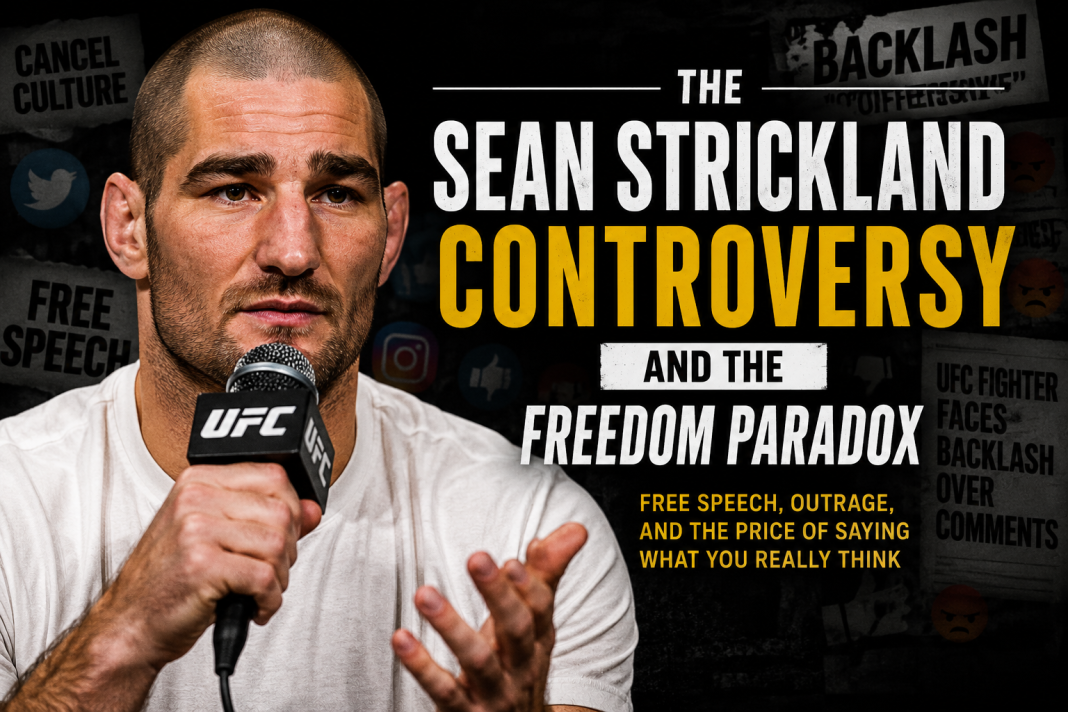
The Sean Strickland Controversy and the Freedom Paradox
Sean Strickland has become one of the most polarizing figures in mixed martial arts. While some fans admire his willingness to speak his mind regardless of the consequences, others view many of his comments as offensive, inflammatory, or irresponsible.
The controversy surrounding Strickland raises a larger question that extends far beyond the UFC: How do we balance free expression with social consequences in an increasingly connected world?
More Than an MMA Story
For many observers, the debate is not really about Sean Strickland at all. It is about the limits of acceptable opinion.
In today’s media environment, public figures are under constant scrutiny. Every interview, social media post, and off-the-cuff remark can be amplified, dissected, and debated within minutes. Supporters argue that individuals should be free to express unpopular opinions without fear of professional punishment. Critics argue that public speech carries responsibility and that controversial statements deserve criticism.
The tension between these positions has become one of the defining cultural debates of our time.
The Freedom Paradox
The freedom paradox emerges when societies simultaneously value free expression while also encouraging social accountability.
Most people support free speech in principle. The challenge comes when speech is viewed as offensive, controversial, or harmful. At that point, competing values begin to collide.
Should people be free to say things others strongly disagree with?
Should employers, sponsors, or organizations respond when those statements create public backlash?
Where is the line between accountability and censorship?
These questions have no simple answers, but they are increasingly relevant in a world where public conversations unfold in real time.
Why Strickland Became a Lightning Rod
Sean Strickland’s blunt communication style makes him an ideal figure for these debates. He often expresses opinions that many people find provocative, while refusing to soften his views to avoid criticism.
As a result, he has become a symbol for two very different perspectives.
To supporters, he represents authenticity and the willingness to speak openly despite public pressure.
To critics, he represents the normalization of rhetoric that they believe can be harmful or divisive.
The intensity of the reaction to his comments demonstrates how deeply divided modern audiences have become over questions of speech, culture, and social norms.
Looking Beyond the Headlines
Whether one agrees with Sean Strickland or not, the broader conversation is worth examining.
The real issue is not a single fighter, interview, or controversy. It is the evolving relationship between free expression, public opinion, media amplification, and institutional power.
As technology continues to shape how information spreads, these debates will likely become even more common.
The challenge for society is not merely deciding what should or should not be said. It is learning how to navigate disagreement without abandoning the principles that make open discussion possible in the first place.
Sean Strickland may be the latest figure at the center of this debate, but he is unlikely to be the last.